
Updated .
A small vertical baler can have a compact machine footprint while still needing room for loading, door movement, bale handling and maintenance. Before ordering, document the whole workstation and the delivery route. A marked sketch helps Keepway review the proposed configuration against the space available at your site.
This checklist addresses site preparation and purchasing decisions. For material, bale size and pressing-force selection, use the vertical hydraulic baler selection guide. For operator training and handover documents, use the separate operation and handover checklist.
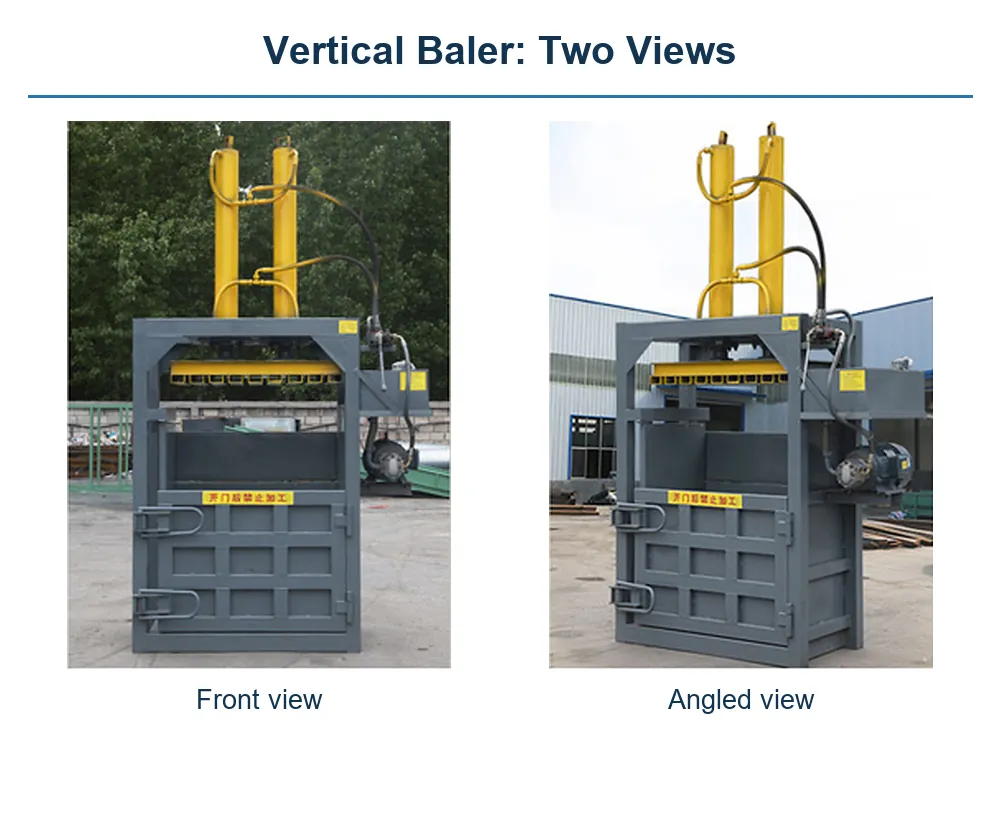
Start with a simple measured sketch
Draw the proposed machine position, incoming material, finished-bale storage, electrical connection point and the route used by handling equipment. Mark doors, columns, fixed shelves and overhead obstructions. Label units explicitly: millimetres and metres, or inches and feet. An unlabelled measurement can make an otherwise useful drawing misleading.
Distinguish measurements you have checked from estimates. Include a few photographs with their viewing direction marked on the sketch. Avoid relying on a wide-angle photograph to judge clearances. If the location is shared with another operation, show what occupies the area during a normal shift, not only when it is empty.
Compare the machine envelope with the working area
| Area to record | Information from your site | What to confirm before ordering |
|---|---|---|
| Machine position | Available floor area and overhead restrictions | Dimensions, mass and installation requirements of the selected configuration |
| Loading access | Material container, largest pieces and arrival route | Usable opening and the intended loading method |
| Door movement | Nearby walls, columns, racks and pedestrian routes | Door arrangement and operating envelope on the configuration drawing |
| Bale removal | Handling equipment, pallet arrangement and destination | Discharge method and the complete removal route |
| Service access | Access to the motor, controls and hydraulic components | Model-specific service clearances and access requirements |
| Delivery route | Unload point, openings, corners and indoor route | Shipping dimensions, handling method and receiving responsibilities |
Do not estimate an installation or safety clearance by subtracting catalogue dimensions from the room size. Ask for the required envelope and clearances in writing, and have the site's responsible personnel review them. Floor suitability, unloading and placement also need to be checked for the actual machine and handling method.
Plan the finished bale before the first load
Confirm the recycler's accepted material, bale dimensions, weight and tying requirements. Then show how a completed bale will leave the machine, where it will wait and how it will reach the collection vehicle. A bale that fits inside the chamber is not automatically convenient for the site's pallet truck, forklift or storage arrangement.
For confirmed Keepway 60T and 80T configurations, push-out discharge is available as an option and must be included in the quotation and order. Do not assume that every photograph or tonnage includes this option. The proposed handling route should match the discharge system actually supplied.
Describe the supply at the installation point
Provide voltage, phase and frequency, together with the destination country. A US, Canadian or European destination does not by itself specify the electrical supply at the intended workstation. Have the responsible electrical professional confirm the available supply and local connection requirements.
The confirmed 8T, 10T and 20T configurations require no machine assembly and can be used after connection to the specified supply and completion of the supplied pre-start checks. This does not remove site preparation, training or connection requirements. Confirm the installation scope for other models separately.
Check the workflow with real quantities
Record typical and peak material quantities per shift, the container sizes used and how often collection takes place. Include loading, pressing, tying, removal and changeovers when discussing capacity. Ask the supplier to state the material and conditions behind a proposed output; a hydraulic cycle time alone does not describe a complete working shift.
For a trial or acceptance review, agree what will be observed: material condition, finished-bale dimensions and weight, handling method and interruptions. Keep the result with the agreed configuration. This makes a later comparison meaningful without assuming a fixed saving in labour, space or transport costs.
Send one coordinated enquiry package
- Marked site sketch, measurements and photographs.
- Material description, sample availability and typical/peak quantities.
- Required bale dimensions, weight and recycler requirements.
- Electrical supply and destination.
- Delivery route, handling equipment and any requested discharge option.
Request a configuration and site-layout review. Compare the vertical baling press range with your requirements; the selected drawing and quotation determine the equipment supplied.
Keepway service
Two-year warranty, with replacement parts and shipping of those parts supplied free of charge during the warranty period. Lifetime after-sales service and technical support are available.