
Updated .
Planning a carton sealing and bundling station means defining the handoffs between operations. This page is a project-planning example, not a report of a verified customer installation or measured customer results.
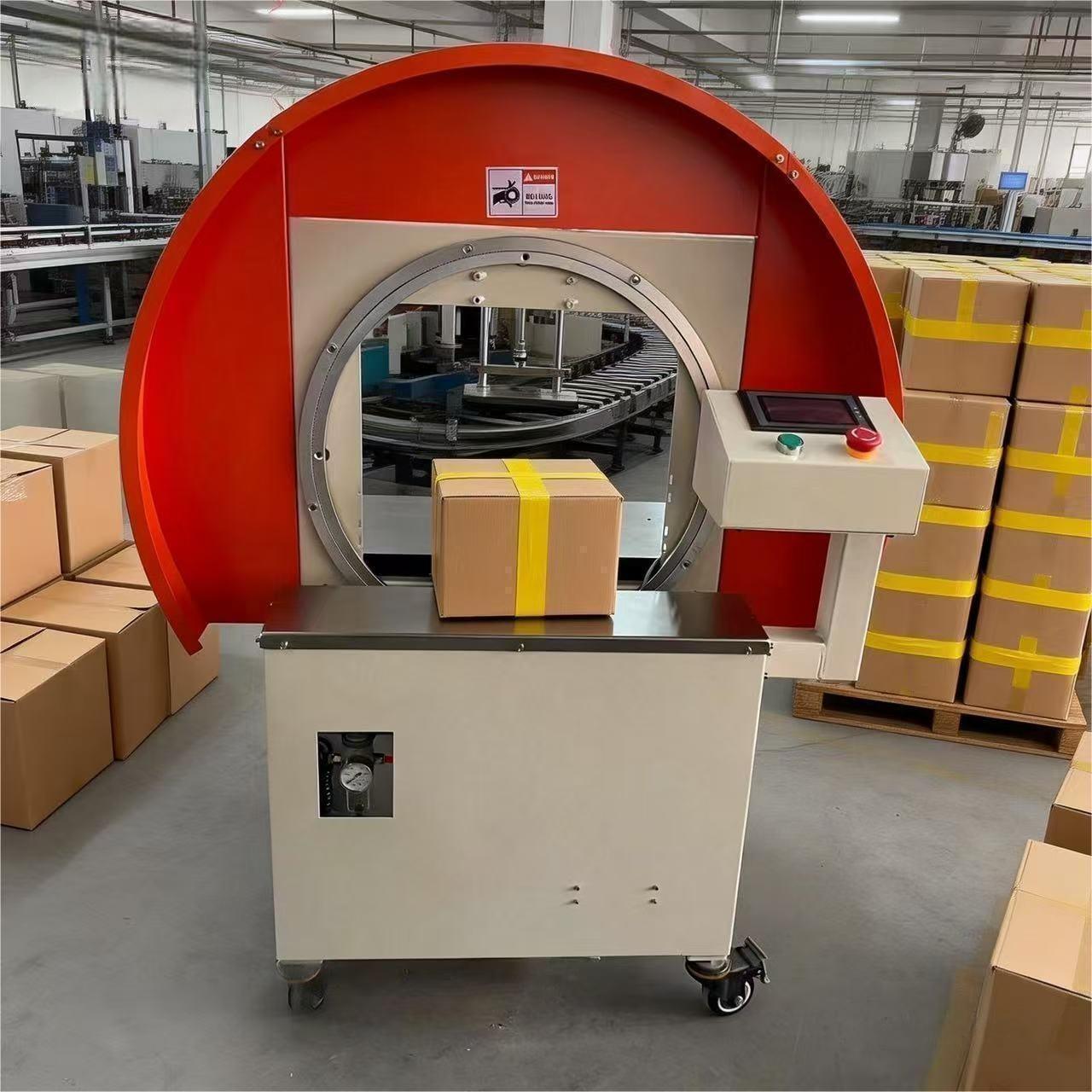
Begin with the packing sequence
Describe the flow in order: prepare the carton, load the contents, close the flaps, apply the required tape, reposition if necessary, inspect, then transfer to the next station. Mark who or what performs each task. A ring tape wrapper addresses the wrapping step; upstream carton erection and downstream palletizing must be listed separately if needed.
Define each interface before asking for a line price
| Interface | Information for review | What the quotation should resolve |
|---|---|---|
| Incoming cartons | Filled L × W × H, weight, stiffness and orientation | Support, handling clearance and acceptable size range |
| Flap closure | How flaps arrive and the intended seam seal | Operator tasks or separately specified closing equipment |
| Tape wrapping | Marked tape path, tape SKU and roll dimensions | Application configuration and sample acceptance |
| Transfer | Station layout, conveyor height if present and available space | Manual transfer or defined conveyor scope |
| Controls and utilities | Destination supply, upstream/downstream sequence and stop conditions | Included interfaces, exclusions and safe operating procedure |
Do not size the line from one catalogue number
The linked KPW-3040 carton tape wrapping machine has a confirmed reference carton footprint of 300 × 400 mm, length × width. That does not establish a complete line capacity or a full carton-size range. Send box height and the remaining sizes for review. For conventional top-and-bottom seam closure, compare the carton tape sealer as a separate process choice.
Make the sample trial measurable
- Agree representative filled cartons, including difficult sizes or surfaces.
- Record tape identification, station setup, operator duties and the observation interval.
- Count accepted cartons and rework, retaining the reasons for stops.
- Check tape placement and later adhesion using the material compatibility checklist.
- For frequent size changes, include the actual batch order and changeover observations.
Evaluate the bottleneck across the whole sequence. A wrapping-cycle demonstration alone does not substantiate the number of cartons an operator can complete during a shift. Any payback calculation should use measured current labour, consumables and rework, plus the tested proposal and your own costs.
Ask for service scope in writing
Include installation responsibilities, training, wear parts, troubleshooting arrangements and the destination in the quotation request. Ask which support and spare parts are included and which are separately quoted. Response and delivery times must be agreed for the order; they are not established by this planning example.
Send a brief we can review
Provide the carton schedule, filled samples or photographs, tape data, target accepted output, station layout and required handoffs. Add your company, contact name and reply email. We can then discuss a machine or station proposal against the specific process rather than an assumed complete line.
Request a carton wrapping station review
Have only the carton and a photo? Start there.
Send the filled carton dimensions and weight, plus a photo with the tape path marked. Mention any missing tape or configuration information so it can be reviewed during the discussion.
Download the carton and tape enquiry checklist to organise the remaining details at your own pace.