
Updated .
Buying an automatic sealing and shrinking line involves more than matching a sealer to a tunnel. The quotation should explain how products enter, how film is applied and joined, how packs pass through the tunnel, and who handles every transfer. Start with a diagram of the intended finished pack and a list of actual product formats. Then compare suppliers against the same equipment boundary.
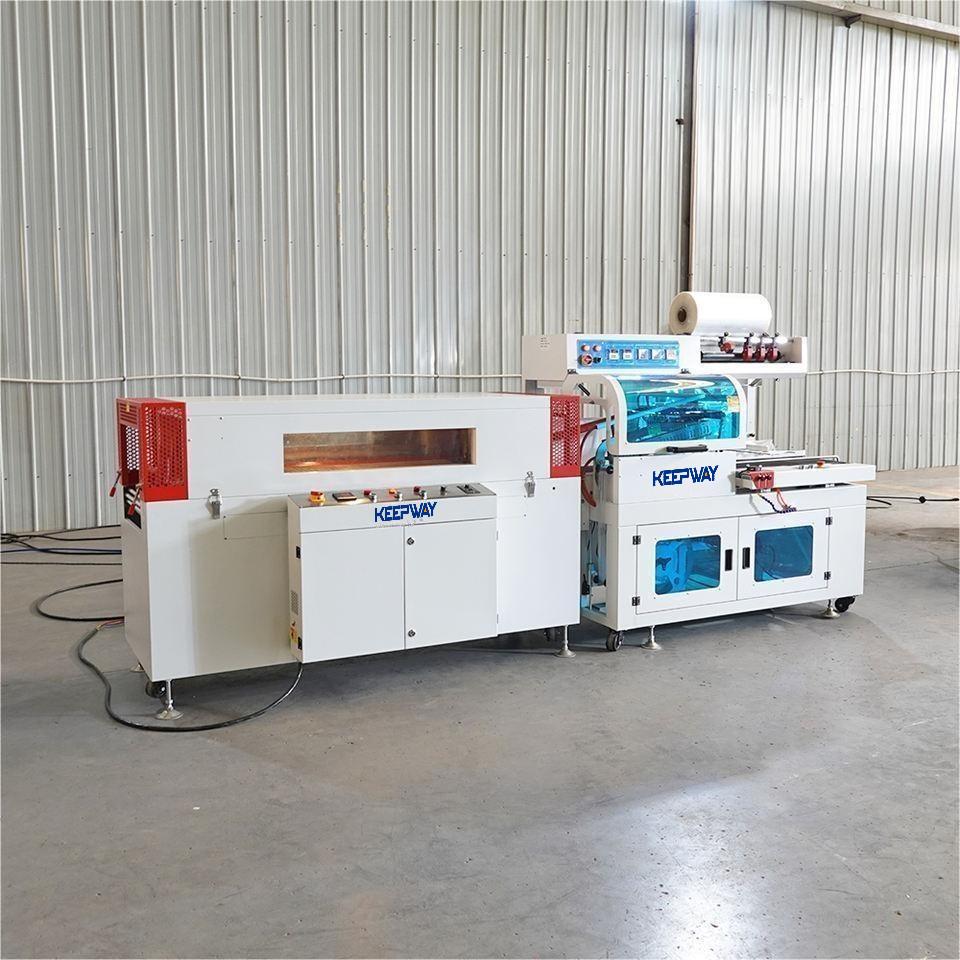
Describe the package before naming the machine
An L-sealer configuration and a sleeve-bundling configuration address different film arrangements and product-handling requirements. A product name containing “automatic” does not tell you whether grouping, loading or collection is automatic. Send photographs of the unwrapped product and the desired finished pack. Mark whether the job is an individual carton, several loose containers, or a group supported by a pad or tray.
For individual packs, review the Keepway L-sealing and shrink-wrapping equipment. For grouped containers, review the semi-automatic sleeve-sealing arrangement. Confirm suitability using the actual product and film; the linked equipment must not be treated as interchangeable simply because both processes use heat.
Ask for an itemised boundary of supply
| Stage | What the buyer should identify | What the quotation should state |
|---|---|---|
| Product preparation | Product condition, pack count, grouping pattern and support | Manual tasks and any quoted grouping or feeding equipment |
| Film and sealing | Film specification, pack envelope and intended seam | Selected sealing configuration, film handling and changeover scope |
| Transfer and shrinking | Pack support, orientation and permitted heat exposure | Matched tunnel, transfer arrangement and necessary site services |
| Collection and inspection | Where the accepted pack goes next | Collection method, downstream interface and operator access |
Ask the supplier to mark each item as included, separately priced, supplied by the buyer, or still to be designed. Include interconnecting conveyors, controls, guarding, documentation and commissioning responsibilities. This makes two prices comparable without assuming that everything visible in a workshop photograph will be delivered.
Confirm services for each ordered model
Record voltage, phase, frequency and the available site connection. If compressed air is needed, ask for the pressure, consumption and air-quality requirement of the actual configuration. Electrical ratings and air pressures from one model are not default values for the rest of a range. Have the supplier review the sealer and tunnel together, rather than checking only the smaller machine.
A dimension labelled as machine length or height is not the usable pack opening. Supply minimum and maximum product dimensions in the intended travel direction, including any tray and film allowance. Request a layout showing the relevant clearances and maintenance access. Do not select a line from an isolated “maximum size” copied from a different product table.
Measure accepted output across the complete workstation
Agree a representative trial covering preparation, feeding, sealing, shrinking, inspection and removal. Count accepted finished packs during the agreed observation period and record rejects, stops and operator tasks separately. Note film changes and format changes if these form part of the normal shift. A conveyor setting or a sealing cycle alone does not establish finished packs per hour.
Document the product format, film supplier code, settings and staffing used in the demonstration. Define the acceptance criteria before the trial: pack appearance, seam condition, product deformation, grouping and the handling checks relevant to the proposed shipment. Appearance alone does not prove that an outer wrap is waterproof, sterile, antistatic or tamper evident. Any such requirement needs a suitable packaging specification and its own supporting evidence.
Plan a repeatable handover
Request the final layout, equipment identification, instructions for the delivered configuration and a record of approved sample settings. Identify who trains operators, who connects site services and how future format changes will be reviewed. For daily production preparation, use the sleeve-machine handover checklist with the model-specific instructions.
Keepway uses 2020 as its company-experience reference year; this information was updated on 3 October 2026. Equipment selection should still rest on the proposed configuration and evidence for your pack, rather than an unsupported longevity or productivity claim.
Keepway service
Two-year warranty, with replacement parts and shipping of those parts supplied free of charge during the warranty period. Lifetime after-sales service and technical support are available.
Request a complete line scope
Send product photographs, minimum and maximum pack dimensions, filled weight, grouping pattern, film details, required output, site layout and destination supply. State which preparation and collection tasks you want included.
Request a sealing and shrinking configurationEmail KeepwayCall Keepway