
Add: Wanda Plaza, Fuqiao Street, Rencheng District, Jining City, Shandong Province, China
+86-18206519878
A conveyor feeder quotation may give speed in metres per minute while your production plan needs accepted pieces per minute. These figures describe different things. Before comparing suppliers, define the product's travel direction, the space between consecutive pieces and the point where a piece becomes acceptable to the next process.
This guide concerns a single stream of separated flat products. It helps you prepare a capacity brief and review a demonstration; it is not a machine operating procedure or a promised production rate. Discuss your conveyor feeder output requirement.
Belt linear speed describes distance travelled per unit of time. A value in m/min does not tell you how many individual items have separated successfully. Piece rate counts individual items passing a defined observation point. Accepted output counts only the items that satisfy the agreed condition at the agreed delivery point.
Ask which of these a quotation describes. Also identify whether the figure refers to continuous running, an observed trial including normal interruptions, or a complete process after a separate operation. Do not compare an uninterrupted conveyor figure with an accepted production-window result as though they were equivalent.
For one lane of equally spaced, non-overlapping items moving at constant speed, the repeat distance from one leading edge to the next is the pitch. It equals the item length in the direction of travel plus the clear gap after it. Width across the belt is a different dimension.
Pitch (mm) = travel-direction item length (mm) + clear gap (mm)
Geometric piece rate (pieces/min) = belt speed (m/min) × 1,000 ÷ pitch (mm)
The calculation assumes that the items move with the belt, the spacing stays constant and no time is lost. It does not prove that the separator can create this stream, that the material will remain aligned or that the next machine can receive it. Overlapping, slipping, irregular gaps, starts and stops invalidate this simple steady-stream assumption.
Consider an imaginary stream travelling at 40 m/min. If each item occupies 250 mm in the travel direction and the clear gap is 150 mm, the pitch is 400 mm. The calculation gives 40 × 1,000 ÷ 400 = 100 pieces/min. With a 350 mm travel length and the same gap, the pitch becomes 500 mm and the calculated rate is 80 pieces/min.
These invented examples demonstrate units and geometry. They establish neither a supported product length nor a capacity for either KPW model. Rotating an item changes its travel length and its width across the belt; both dimensions and the material's behavior must be reviewed before choosing an orientation.
A small gap may increase the geometric rate, but it is useful only if the receiving process can work with that spacing. Ask the supplier of any separately specified coding, marking, inspection or collection equipment what product position and spacing it needs. Check the real transfer arrangement rather than taking a belt speed as proof of a complete line's capacity.
Write down who supplies the separation mechanism, transport, product detection and any required timing or control interface. A requirement for these functions does not establish that they are included. A quotation should name the proposed equipment and explain how its suitability will be demonstrated.
Agree an observation point with the supplier, such as the delivery position after the feeder conveyor. Define acceptable separation, orientation, alignment and product condition there. If another operation is included in the purchase decision, identify that additional acceptance point separately.
Use representative production samples and an agreed observation period. Record material version, feeding orientation, guide/separation setup reference, belt-speed setting, actual spacing and the receiving arrangement. Log overlaps, doubled pieces, skew, damage and interruptions; retain unsuccessful observations after adjustments rather than reporting only the fastest sequence.
Observed accepted pieces/min = accepted pieces at the defined point ÷ elapsed observation minutes. State whether replenishment, waiting for the receiver and other ordinary pauses are inside that period. Where a running-only observation is also useful, label it separately. Do not apply an assumed efficiency percentage to a geometric calculation and present the result as measured output.
Product finish, stiffness and stack condition deserve their own recorded sample references. A result for one stock and stack condition does not approve every stock with the same outline. Agree the test duration, repetitions and acceptance criteria for the actual job; no universal pass rate or test length is prescribed here.
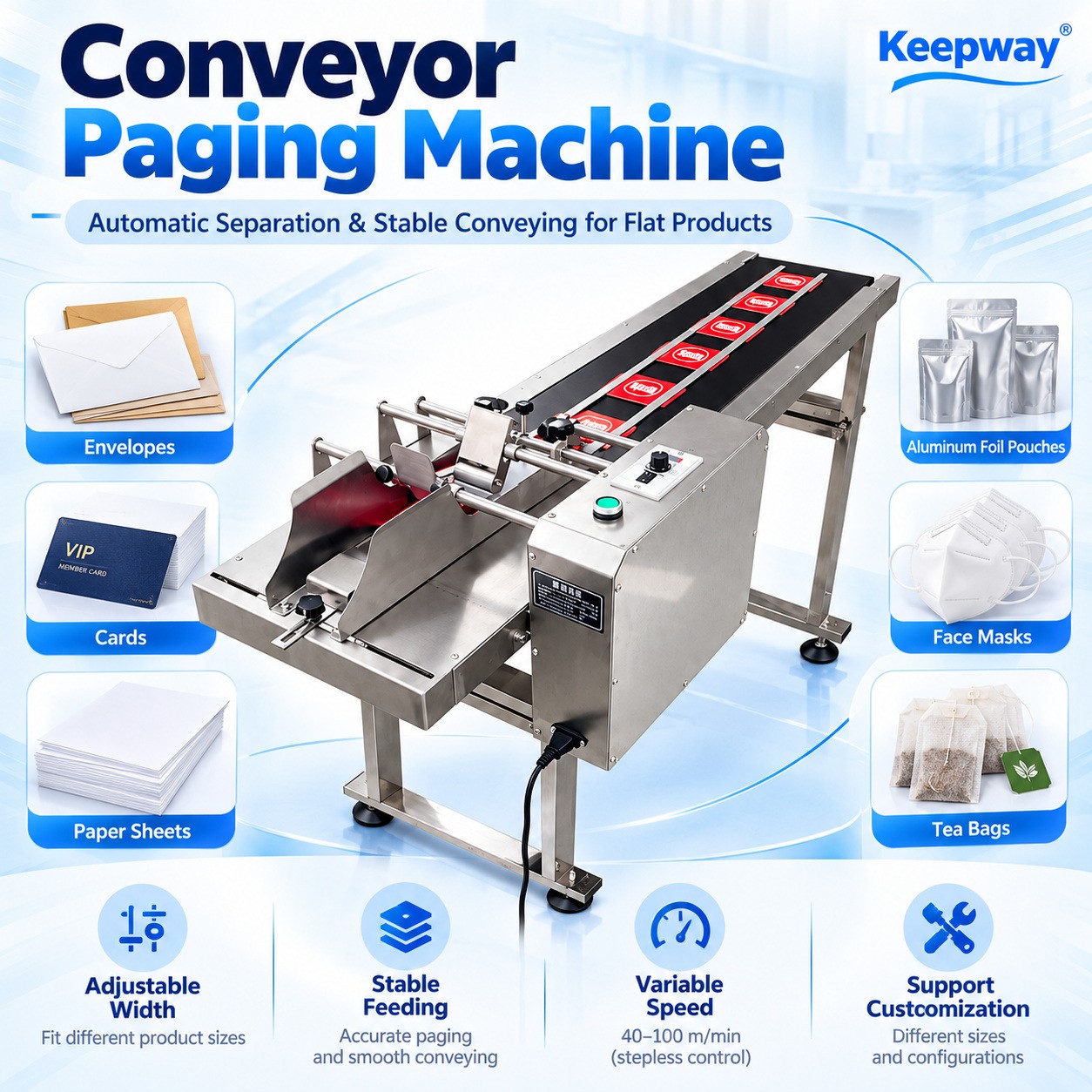
The KEEPWAY KPW-9001 / KPW-9005 conveyor friction feeders have a confirmed belt-speed range of 40–100 m/min and a confirmed complete-item thickness range of 1–5 mm. Supported product widths are 80–360 mm for KPW-9001 and 100–500 mm for KPW-9005. Ordinary thin sheets or films below 1 mm are outside that stated thickness range. Product-length limits and the receiving arrangement require review.
Those specifications describe continuous separation and belt transport. They do not establish preset counting, batch formation, automatic inspection, synchronized transfer or an included printer or bander. A feeding-and-banding proposal uses a separately specified banding machine.
For confirmed preset-quantity card dispensing, compare the separate KPW-150 / KPW-300 / KPW-420 tabletop batch feeders. If your purchase concerns keeping each preset group intact through collection and banding, use the batch handover acceptance guide; that is a different decision from converting a conveyor speed into a capacity brief.
Copy this blank record into your inquiry or trial document. Complete the agreed requirements first and leave observations blank until a trial takes place. It is a planning aid, not a completed test or certification record.
CONVEYOR FEEDER OUTPUT BRIEF — BLANK RECORD
Job / material reference and revision:
Proposed feeder model and equipment included:
Production sample / finish / complete-item thickness range:
Travel-direction length and width across belt:
Proposed orientation / required clear gap at receiving point:
Required accepted output and where it is counted:
Receiving equipment / height / transfer and control scope:
Trial duration, repetitions and included/excluded pauses:
Agreed criteria for separation, alignment and product condition:

OBSERVATION — COMPLETE ONLY AFTER TRIAL
Sample and setup reference / speed setting:
Observed pitch or gap behavior:
Elapsed period / accepted pieces / observed accepted rate:
Overlaps, doubles, skew, marks and other held/rejected pieces:
Replenishment, receiver waiting and other interruptions:
Changes made / earlier results retained / unresolved points:
Evidence reference / buyer and supplier review:
Send your sample photos, both product dimensions, complete-item thickness, surface finish, intended orientation, required accepted output and the next process. Include available space and the local electrical supply. Ask for the proposed configuration and an agreed demonstration that reports its conditions alongside the result.
Review my KPW-9001 / KPW-9005 application
MABEG's sheet-feeder overview treats separation, transport and the customer's requirement profile as distinct design considerations. Superior-PHS's Xtreme manual, page 18 discusses how friction, rigidity and stack loading affect feeding. cab's applicator specification lists package speed, spacing and cycle rate separately. These sources inform the purchasing questions; their features and performance are not KEEPWAY specifications. Reviewed 22 October 2026.
Mobile:+86-18206519878
Tel:+86-18206519878
Whatsapp:8618206519878
Email:sales@kbwmachinery.com
Add:Wanda Plaza, Fuqiao Street, Rencheng District, Jining City, Shandong Province, China