
Add: Wanda Plaza, Fuqiao Street, Rencheng District, Jining City, Shandong Province, China
+86-18206519878
A continuous band sealer may close a pouch successfully while its date or lot code is hard to find, partly missing or hidden after packing. Before ordering a coding option, approve a finished, filled bag carrying your actual message. A photograph of a coding wheel does not establish which text, position or print quality the quoted machine can deliver.
This guide helps small manufacturers and contract packers specify date and batch coding on pre-filled, heat-sealable bags. For the wider material and sealing trial, use the bag sealer sample-test checklist. Here, the purchasing decision is whether the proposed coder produces the required mark on the actual finished pack.
Review a band sealer and coding requirement
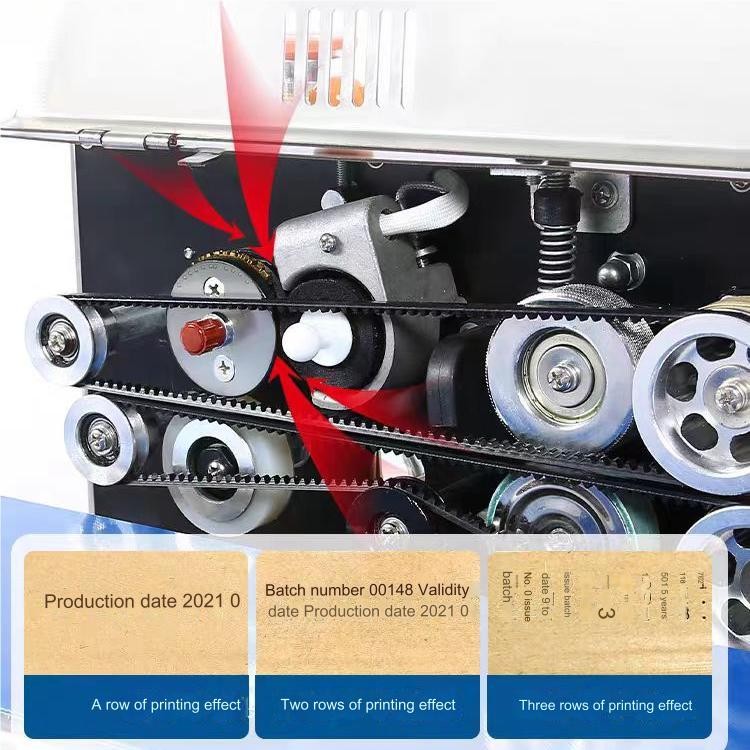
“Print the date” leaves important choices unresolved. Send the complete required text, its order, date format, spaces, punctuation and number of lines. Include a longest planned lot identifier, rather than demonstrating only a short number that is easy to fit.
Identify who supplies and approves the information. Ask the supplier to show how the proposed configuration sets or changes it. Do not assume automatic date advancement, stored jobs, a real-time clock or a connection to your production system. A mechanically set message and electronically supplied variable data are different requirements.
For technical background, Sealer Sales distinguishes embossing and dry-ink coding on its own band sealers. This illustrates why a buyer should identify the marking method explicitly. It does not establish which method is supplied on a Keepway quotation.
Provide the bag supplier’s material construction, thickness basis and artwork revision. Mark the open edge, intended seal area and requested code area. Add the zipper, tear notch, gusset or fold where present, and identify any preprinted panel that the message must avoid.
Agree a measurable reference for the position, such as the open edge and one side of the bag. Ask the equipment supplier to confirm the achievable location and permitted variation on the proposed configuration. There is no universal edge clearance or print window specified by this guide.
Use the real filled bag when reviewing the drawing. Contents can change how the mouth is presented and how the finished top folds during packing. If a customer needs the code to remain after opening, show the intended opening route and ask whether the requested position can meet that requirement before ordering.
Ask for close-up photographs of the whole message and a wider view showing where it sits on the filled pouch. Compare every character with the approved text; distinguish missing or broken characters, a wrong message, poor contrast and a mark in the wrong place.
For an ink-based proposal, agree how print adhesion or rubbing will be evaluated on the actual outer film. For an embossed proposal, agree how the mark will be read on the chosen colour, finish and seal pattern. The supplier should select operating settings under the delivered instructions; a setting from another bag or machine is not an approved recipe.
Review the seal after cooling as well. An attractive code does not demonstrate a sound seal, and an attractive seal does not demonstrate a readable code. Where package integrity or another defined performance matters, have your packaging or quality team specify the evaluation and acceptance criteria.
| Approval question | Evidence to request | Keep separate |
|---|---|---|
| Is the message correct and complete? | Actual longest approved text on an identified bag sample | Text correctness and character clarity |
| Is the position useful? | Whole filled pouch, with the code measured from agreed references | Code position and seal location |
| Can it be read after packing? | The normal fold, collection and carton-packing arrangement | Immediate appearance and later handling observations |
| Does the bag remain acceptable? | Recorded seal inspection and any separately agreed package tests | Coding appearance and verified package performance |
Do not stop the review at the conveyor exit. After the agreed cooling and handling period, place samples as they will normally be collected, folded and packed. Check whether the code becomes covered, difficult to read or marked by contact with another pack. Record the condition, elapsed time and observation rather than claiming permanent resistance from one demonstration.
If the pack will be stored or used in particular conditions, give those requirements to the packaging and equipment suppliers. Agree a suitable evaluation before approval. This checklist supplies no universal rub test, storage duration or acceptance limit.
Include a planned message change in the demonstration. Retain an identified sample before the change and an approved first sample afterwards. Agree who checks the message and how uncertain bags are held for review. These are workflow requirements to define; they do not imply automatic inspection or rejection equipment.
The Keepway continuous band sealer product page shows several configurations and asks buyers to confirm date or batch coding in the quotation. Ask for the proposed marking method, demonstrated text layout, included character sets or consumables, change procedure and replacement-item identification. Record any separate equipment explicitly.
A printed illustration does not confirm a supplied printer type, a particular number of lines or the ability to print barcodes. If your requirement includes a machine-readable symbol, changing data for every bag or a larger message outside the available area, request a separate capability review. Do not infer these functions from a simple date-code example.
Use one blank record for each bag revision and proposed configuration. Fill observations only after the agreed trial; this is not a completed test result.
BAND SEALER CODING APPROVAL — BLANK RECORD
Bag supplier / material / artwork revision:
Filled dimensions / weight / presentation:
Proposed machine and coding method:
Exact approved message / longest version / line layout:
Code position reference / requested tolerance:
Quoted character or data limits:
Coding consumables and items included:
Trial sample identification / settings reference:
Message correctness / clarity / position observations:
Cooling or handling condition / elapsed time:
After-handling readability / print observations:
Separate seal evaluation / evidence:
Message-change first sample / reviewer:
Decision / unresolved item / revision:
Send Keepway your bag specification, an artwork or annotated photograph, filled weight, exact message, preferred position and required packing pace. Add the destination power supply and any particular handling conditions. We can review the sealing configuration and coding requirement together; the included equipment and approval criteria should be agreed for your quotation.
Mobile:+86-18206519878
Tel:+86-18206519878
Whatsapp:8618206519878
Email:sales@kbwmachinery.com
Add:Wanda Plaza, Fuqiao Street, Rencheng District, Jining City, Shandong Province, China