Add: Wanda Plaza, Fuqiao Street, Rencheng District, Jining City, Shandong Province, China
+86-18206519878
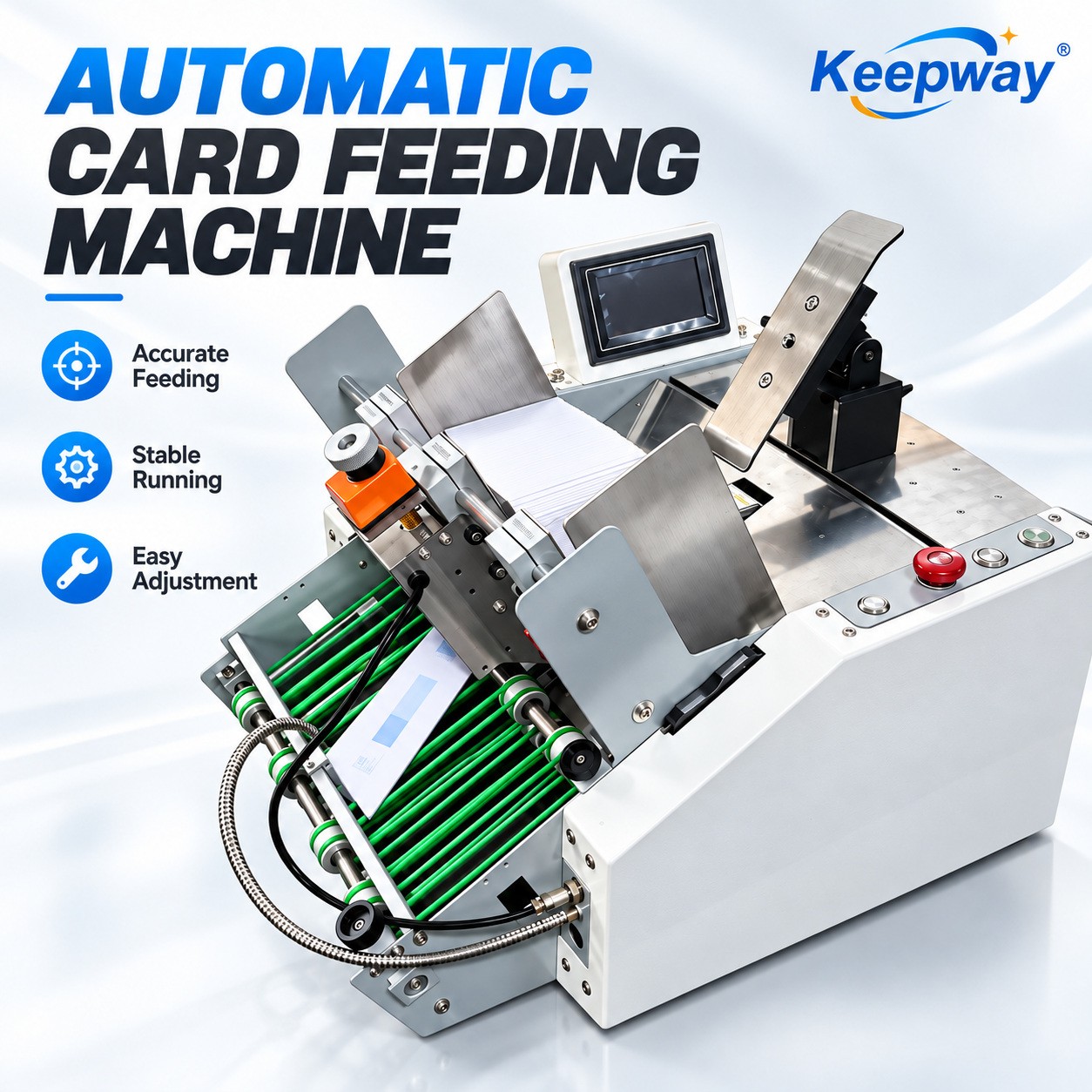
The KEEPWAY KPW-150, KPW-300 and KPW-420 are tabletop friction feeders for separating stacked cards, coupons, leaflets and other suitable flat products. Preset quantity and batch feeding help organize repeat jobs before collection, packing or a separately configured downstream process. Choose the model around the actual product footprint, thickness and required batch, then verify the material in a feeding trial.
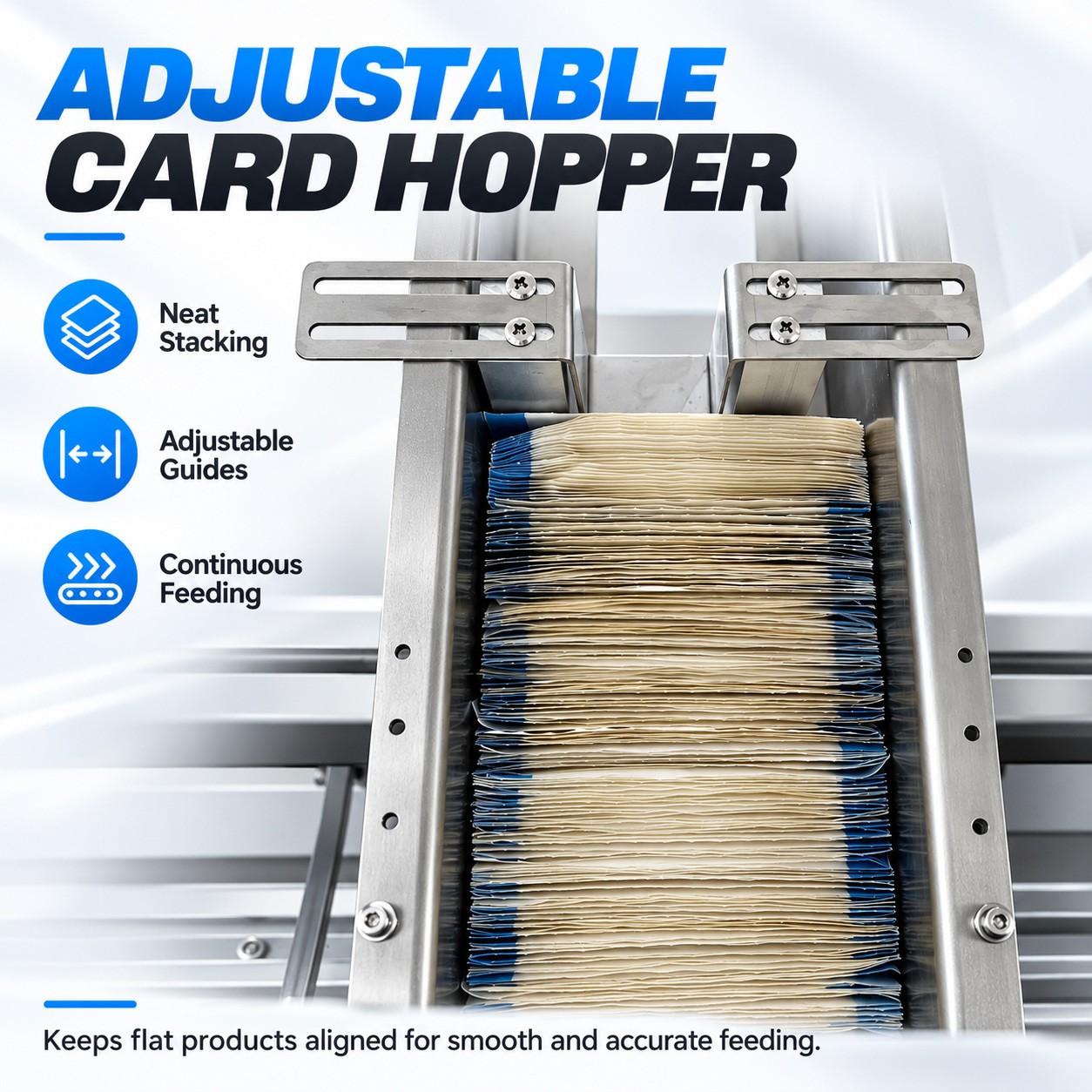
For print finishing, packaging inserts and card preparation: the series combines adjustable guides, a touchscreen, servo drive and pneumatic components. A conveyor, automatic hopper, collection arrangement or production-line connection is an additional configuration. A banding or strapping machine is separate equipment.
Request a feeder selection and sample trial
Watch the two-card batch demonstration on YouTube
This demonstration uses a preset two-card batch. It shows the feeding result and output arrangement, rather than every touchscreen programming step. The series supports setting a quantity and feeding in batches; confirm the required batch size and collection method with your samples.
Watch the batch feeding and separate banding demonstration on YouTube
This demonstration shows cards fed onto a conveyor, an operator gathering the batch, and a separate downstream banding station. It illustrates a configured workflow; it does not mean that a conveyor or bander is included with every tabletop feeder. Ask us to review collection, transfer space and the next machine together.
Glossy surfaces, curl, static, uneven folds or changes in thickness can affect separation. A dimensions-only comparison cannot establish performance on every stock. The sample trial should check actual pieces per batch, skew, surface marks and the ease of collecting the output.
| Feeding task | Examples to discuss | What to check in the trial |
|---|---|---|
| Card and coupon batch feeding | Printed cards, promotional coupons and similar flat card stock | Dimensions, coating, stiffness, pieces per batch, edge condition and any surface marking |
| Leaflet and instruction sheet feeding | Leaflets, instruction sheets and packaging inserts | Flat or folded format, fold direction, curl, thickness variation and alignment at the outlet |
| Paperboard insert feeding | Flat inserts and suitable paperboard pieces | Actual thickness, rigidity, stack behavior and separation consistency |
| Flat pouch or sachet feeding | Suitable flat pouches and sachets | Seams, local thickness, flexibility and whether the piece remains flat through the feeding path |
| Label or tag pieces | Separate flat label sheets or tags | Backing, exposed adhesive, stiffness and detection with the actual sample; roll-label dispensing is a different process |
Compatibility is material-dependent. Send representative production samples, including the smallest, largest and most difficult versions. Do not infer suitability for filled uneven pouches or every thin film from the stated dimensional range.
| Item | KPW-150 | KPW-300 | KPW-420 |
|---|---|---|---|
| Maximum product size | 150 × 150 mm | 300 × 300 mm | 420 × 420 mm |
| Minimum product size | 50 × 50 mm | 60 × 60 mm | 100 × 100 mm |
| Listed product thickness | 0.06–6 mm; suitability subject to material trial | ||
| Listed stacking height | 300 mm | ||
| Listed feeding/counting speed | 80–200 pieces/min; actual output depends on material, settings and collection method | ||
| Power | 0.4 kW | ||
| Supply options | 220 V / 110 V AC; confirm the required configuration for the destination | ||
| Listed machine weight | 40 kg | 50 kg | 60 kg |
| Listed overall dimensions | 550 × 500 × 600 mm | 650 × 580 × 600 mm | 750 × 650 × 600 mm |
| Additional arrangements | Collection hopper, automatic hopper, conveyor and project-specific integration | ||
The figures above describe the supplied series specification. The size range and speed are not a guarantee for every material at every setting. Confirm machine orientation, service clearance, destination electrical requirements and pneumatic supply during selection. A tested batch size should form part of the agreed trial conditions.
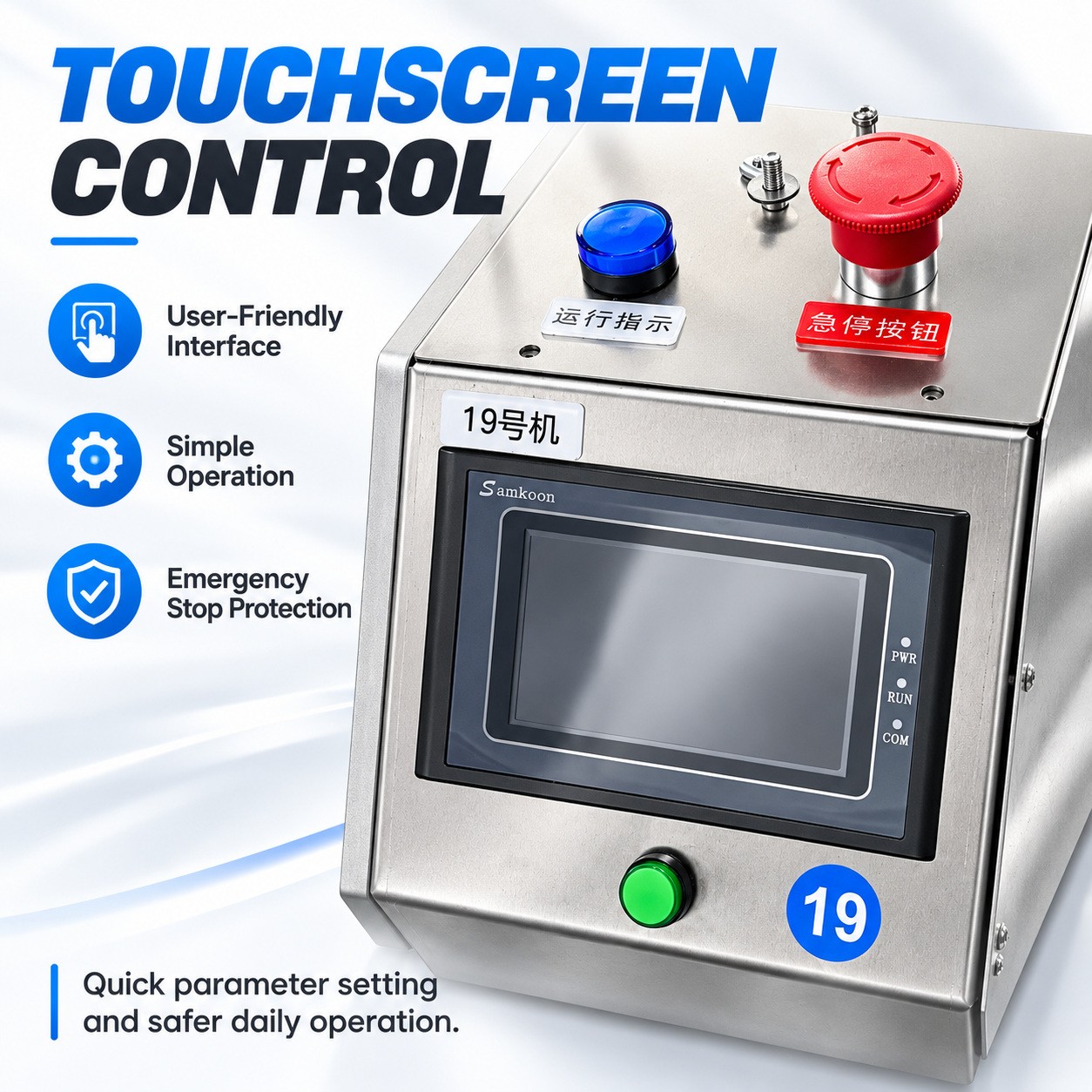
The touchscreen supports quantity settings and batch feeding. Adjustable guides help align different products, while the confirmed servo and pneumatic systems form part of this series. Choose settings against the actual material and check the output after a changeover. An emergency-stop control is shown on the supplied equipment images; operation and access procedures should follow the delivered machine instructions.
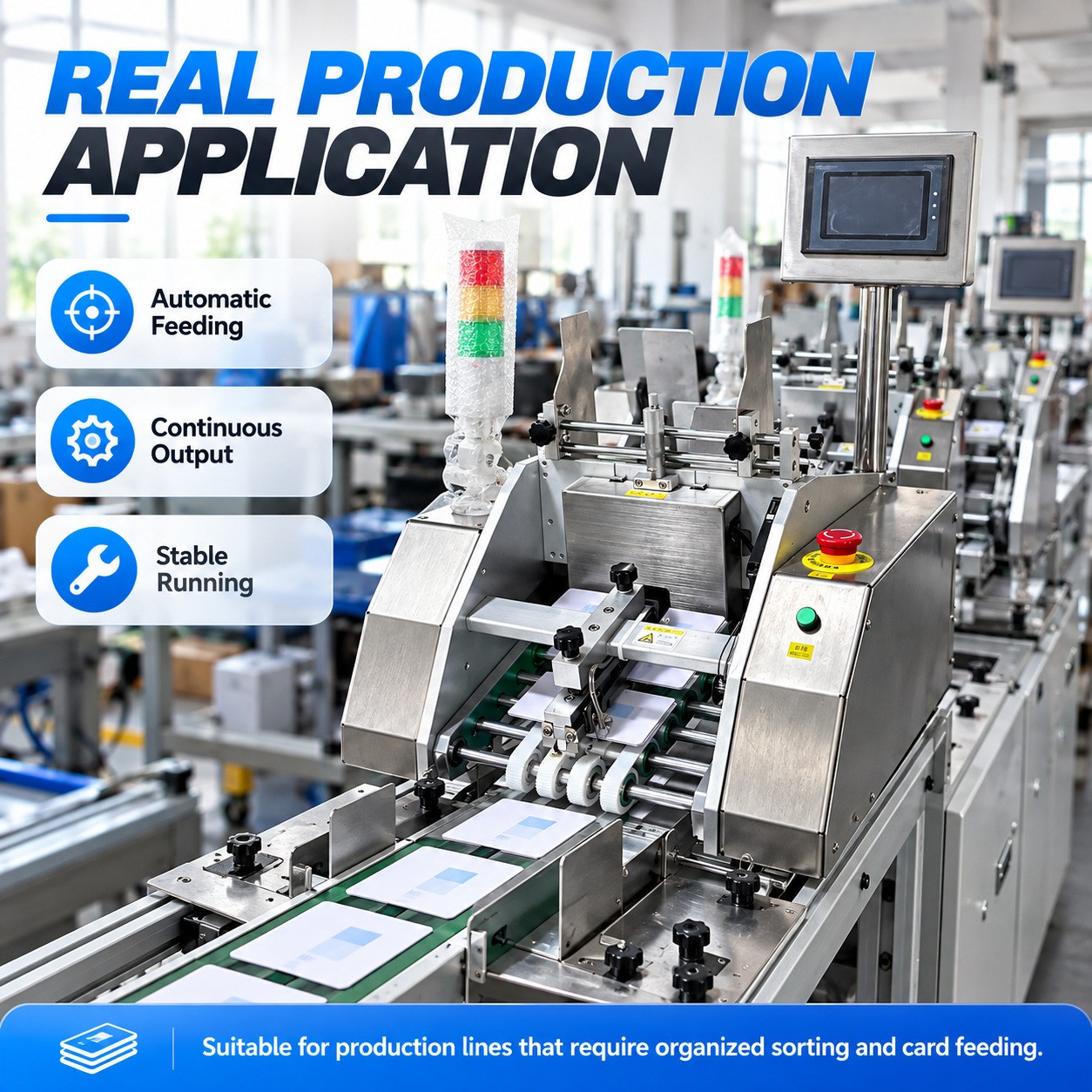
A tabletop card feeder is useful where an operator needs repeat batches at a workbench. A conveyor arrangement can move the output toward collection or another operation. These choices change the required footprint, outlet height, handling method and controls. Discuss the whole path from the stack to the next process before ordering the configuration.
For feeding before banding, confirm the bundle dimensions, how the batch will be gathered and how it reaches the bander. For packaging inserts, describe the receiving process and its cycle. Any external trigger, communication signal, interlock or synchronized operation must be confirmed for the project; these interfaces are not represented here as standard functions.
Send your card size and batch requirement for a configuration review
This machine separates and feeds flat pieces through a discharge path. It can prepare preset batches for a next operation. A paper counting machine addresses a different counting task; compare the required material handling method before selecting equipment.
Yes. The supplied two-card demonstration illustrates this batch setting. Check the count and collection behavior with your own cards before adopting a production setting.
No. The feeder and downstream banding machine are separate equipment. The workflow video includes an operator collecting and transferring the cards. A separately configured paper/OPP banding machine can be discussed for the next operation; compatibility and transfer must be reviewed.
No printer or label applicator is specified as part of this feeder listing. Describe any coding or labeling requirement so the separate equipment and transfer arrangement can be evaluated.
Check both your smallest and largest products against the model range. For example, a 50 × 50 mm item is inside the listed KPW-150 size range but below the listed minimum for the larger models. Do not choose only by maximum width. Also check thickness, stock behavior and the required batch.
No fixed output is promised for every job. Product surface, stiffness, size, batch setting and collection influence results. Request a trial using representative stock and record the conditions alongside the output.
Production-line integration is available as an additional configuration. Share the receiving equipment and required sequence; confirm the physical transfer and any control interface before ordering.
For preset groups such as two cards per batch, check separation, partial groups after pauses, collection and transfer to a separate bander. Use the card feeder batch handover acceptance guide and blank record to prepare a matched demonstration.
Mobile:+86-18206519878
Tel:+86-18206519878
Whatsapp:8618206519878
Email:sales@kbwmachinery.com
Add:Wanda Plaza, Fuqiao Street, Rencheng District, Jining City, Shandong Province, China