
Updated .
Choosing an automatic carton strapping machine starts with the cartons and the way they move through the packing station. An arch that looks large enough, or a short cycle time in a specification table, does not by itself confirm that the machine fits your job. Define the package range, PP strap, number of straps and handling arrangement before comparing quotations.
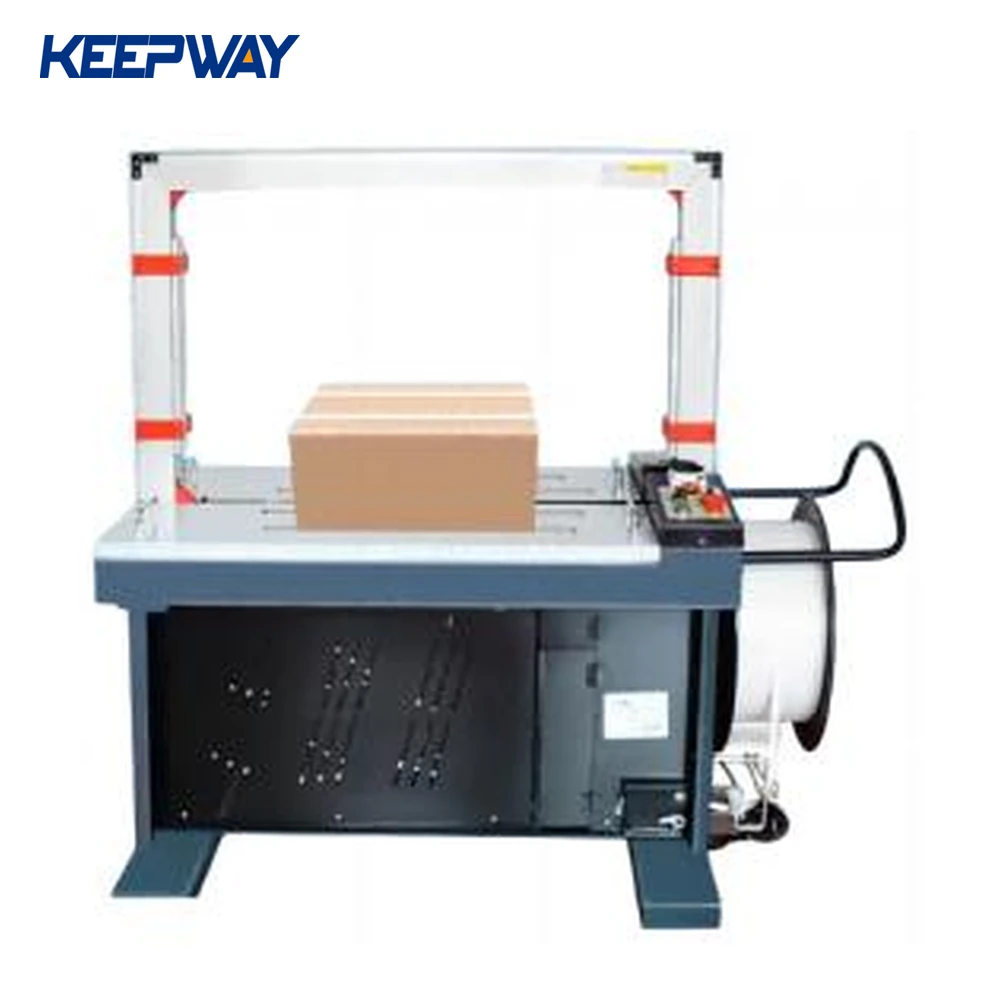
Start with the carton in its strapping position
List the smallest and largest cartons as length, width and height, with gross weight and the orientation used at the station. Explain which face enters the arch and where each strap must sit. Include filled sample cartons: bowed panels, flaps or protrusions may affect handling even when nominal dimensions appear suitable.
Strapping holds the package together for its intended handling requirement; it does not replace a separately required carton-sealing operation. Specify whether cartons arrive closed and taped, how they are supported and how operators or conveyors transfer them to the strapping position.
Distinguish arch size from usable strapping size
The KPW-8060 automatic PP strapping machine has a listed standard arch of 800 × 600 mm. Its listed maximum strapping section is 780 × 580 mm, with a minimum section of 80 × 60 mm. Use the usable strapping section when checking the carton face in the intended orientation; do not quote the larger arch dimensions as the maximum carton size.
A customised arch can be discussed separately. Its clearances, arrangement and resulting machine dimensions need to appear in the quotation. The standard figures should not be carried over to a custom configuration without confirmation.
Keep the strap specification tied to the machine
The listed KPW-8060 configuration uses PP strap 8–15 mm wide and 0.5–1 mm thick. Share the intended roll specification and a sample with the carton. This is a heat-sealed plastic-strap application, not a rope-knotting process. PET compatibility must not be inferred from a generic description of strapping equipment.
Check the finished strap and joint on representative packages. Agree the acceptance criteria for carton condition, joint quality, strap placement and the intended handling before ordering. Material changes after purchase should be evaluated against the approved specification instead of judged only by whether the roll can be loaded.
Convert a cycle reference into a workstation requirement
The product page lists 1.8 seconds per bundle as a machine-cycle reference. It is not a guaranteed finished-carton output. An operator may still need to bring in a carton, align it, start the cycle, reposition it for another strap and move the finished package away.
| Include in the timing trial | Why it changes the result |
|---|---|
| Loading and positioning | Carton weight, operator reach and arrival position affect the time before strapping begins. |
| Straps per carton | A second strap adds a cycle and may require moving or rotating the carton. |
| Removal and transfer | The next station must accept the carton without blocking the worktable. |
| Mixed carton sizes | Changeovers and variation may alter the working rhythm and checking requirements. |
| Roll changes and planned checks | Average output over a representative run differs from a short demonstration. |
As a planning calculation, 3,600 divided by measured total seconds per finished carton gives an approximate hourly rate for that observed cycle. For example, an observed 12-second complete handling cycle corresponds to 300 cartons per hour before additional allowances. This is an illustration, not a KPW-8060 capacity claim. Validate the required rate with your cartons, strap pattern and staffing arrangement.
Define what “automatic” covers in the quotation
An automatic strapping cycle does not establish automatic carton transport. The product page lists several operating modes, but the selected configuration must define how the carton arrives, what starts the cycle, who positions additional straps and how it leaves. Confirm interfaces and responsibility for any separately supplied conveyor, sensor or transfer section.
If the job includes taping, compare the KPW-FX5050 carton tape sealer as a separate station and specify the transfer between sealing and strapping. A combined line, its controls and integration are an additional equipment scope, not something to assume from a photograph of machines together.
Prepare a useful request for quotation
- Minimum and maximum filled-carton dimensions, weight, orientation and photographs.
- Required cartons per hour, straps per carton and strap locations.
- PP strap width, thickness, roll specification and representative material.
- Manual or conveyor loading and unloading, available floor space and a simple station sketch.
- Destination power supply, working conditions and any custom arch request.
- The sample-run checks needed before accepting the selected configuration.
The KPW-8060 page lists a 750 mm table height and single-phase 110/220 V, 50/60 Hz options. Confirm the supplied electrical configuration and station height for your site in the quotation rather than treating the options as a universal interchangeable supply.
Already own a machine and need help?
If output has fallen because of missed feeds, loose straps or poor joints, first use the automatic strapping machine troubleshooting guide. It separates the failing cycle stage from layout and selection questions, and lists the information needed for support.
Keepway service
Two-year warranty, with replacement parts and shipping of those parts supplied free of charge during the warranty period. Lifetime after-sales service and technical support are available.
Match the machine to your carton workflow
Request a KPW-8060 carton strapping configuration with your carton range, PP strap, straps per carton, target output and station sketch. You can also compare the strapping equipment range before confirming the machine and integration scope.