
Add: Wanda Plaza, Fuqiao Street, Rencheng District, Jining City, Shandong Province, China
+86-18206519878
A vertical hydraulic baler can be considered where a business collects a defined recyclable material stream and needs a manageable bale for storage and collection. Selection begins with the material, its daily quantity and the receiver's requirements. A general promise of compact size or high press force does not establish that a machine fits your site.
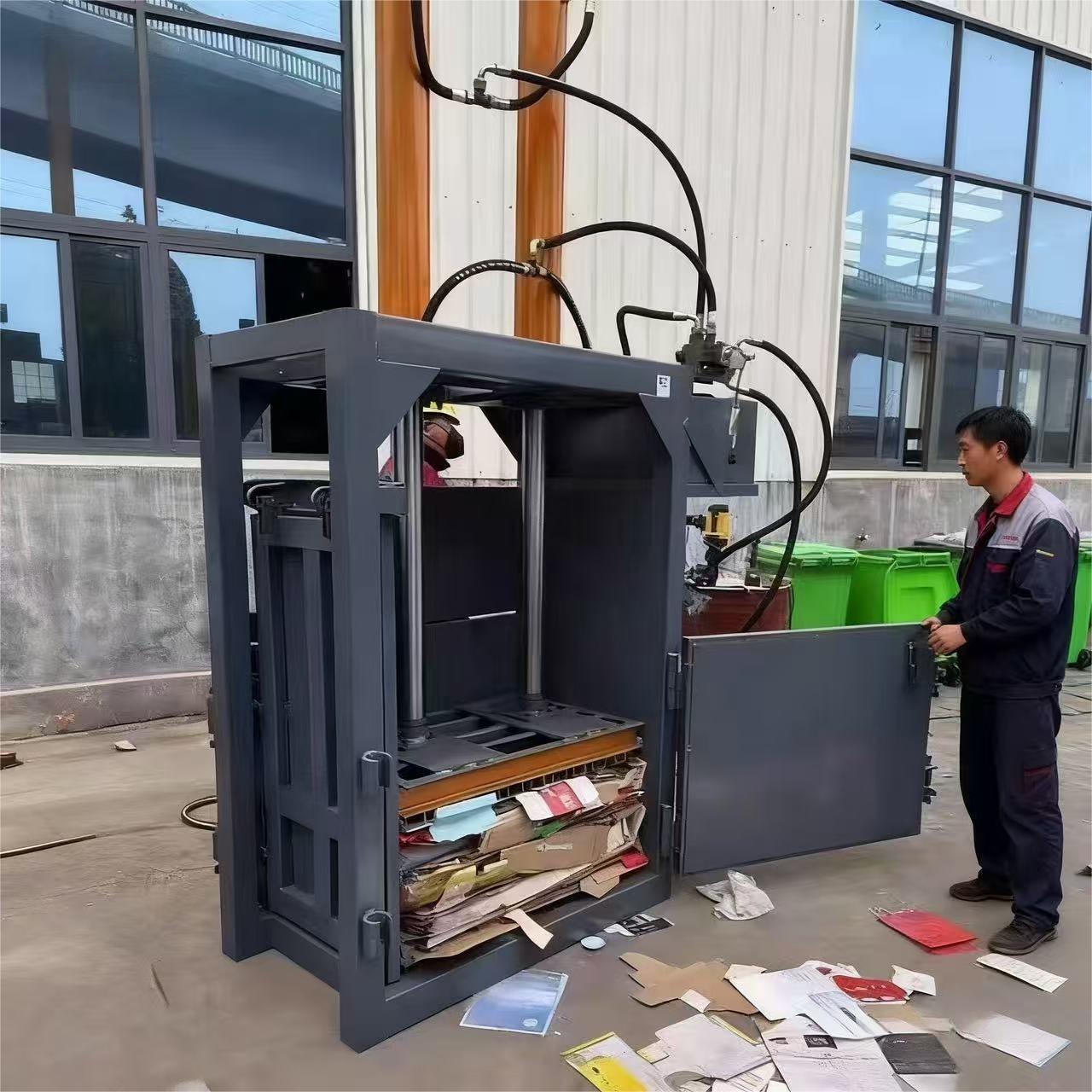
Describe cardboard, paper, plastic film or other proposed material separately. Supply photos, typical dimensions, daily quantity and information about moisture or contamination. Compatibility must be checked for the proposed model; a machine suitable for one stream should not automatically be described as suitable for all recyclables.
Discuss any mixed feed or unusual items before a trial. The material permitted by the supplied operating instructions and the receiving recycler sets the boundary. Keep material preparation, sorting and feeding responsibilities in the application brief.
Use the proposed machine drawing to check its installed dimensions and height. Add the space needed for doors, feeding, tying, bale removal, collection equipment and maintenance access. Check the delivery route and overhead restrictions as well as the final position. The machine footprint alone is not the required working area.
Send a site sketch with access widths, obstructions and the intended bale collection route. If dimensions are not yet confirmed, leave them pending and request a layout review before ordering. Do not use a generic floor-area figure as approval to install a specific baler.
Ask the receiving recycler for accepted material, bale dimensions, tying requirements and handling limits. Then compare these with a representative trial. Bale weight depends on the material and operating conditions; pressing force is not a bale-weight guarantee.
Record input material, loading and pressing time, tying and removal time, and the condition of the finished bale. Include the complete handling cycle when estimating output. Where several material streams are proposed, record separate trial results and acceptance conditions.
Confirm the model, electrical supply, loading and discharge arrangement, and included accessories in the quotation. Keepway's confirmed 8T, 10T and 20T configurations do not require machine assembly after delivery; the correct power connection and the specified pre-start checks still apply. Bale push-out equipment for 60T and 80T configurations is optional and must be included explicitly when required.
These configuration statements do not establish that every material or site is suitable. Follow the supplied instructions and arrange the required operator training and site preparation for the actual machine.
Compare your current collection charges, handling time and storage arrangement with measured trial results and the receiver's terms. Record assumptions separately from measured data. Savings, collection frequency and payback cannot be set by one universal percentage or period.
Compare vertical baler configurationsReview my material and available space
Mobile:+86-18206519878
Tel:+86-18206519878
Whatsapp:8618206519878
Email:sales@kbwmachinery.com
Add:Wanda Plaza, Fuqiao Street, Rencheng District, Jining City, Shandong Province, China