
HOUSEHOLD PRODUCT PACKAGING · PROCUREMENT GUIDE
Shrink Wrapping Laundry Products: A Sample Handover Checklist
A bottle multipack, a detergent carton and a refill pouch present different packaging questions. Before selecting a shrink wrapper, agree what the outer pack must hold together and send samples that represent the product you will actually sell.
This guide is for buyers and co-packers planning secondary shrink packaging around finished laundry or household-care products. It covers the information needed for configuration review and a representative trial. It is not a recipe for exposing an unknown formulation or container to heat.
1. Define the pack that the customer receives
Start with a sketch showing unit count, rows, orientation and the position of handles, caps and labels. State whether the customer buys one item, a promotional pair or a larger distribution bundle. Measure the assembled pack, including any protruding closure; dimensions of one bottle alone are insufficient.
| Pack you are considering | Include in the sample brief | Question to settle |
|---|---|---|
| Filled bottle multipack | Bottles, closures, labels, row arrangement and proposed pad or tray | How will the group stay in position during loading, transfer and collection? |
| Cartons grouped for a promotion | Finished cartons, print finish, bundle dimensions and barcode positions | Which panels must remain readable and what appearance is acceptable? |
| Refill pouches grouped together | Filled pouches and the proposed supporting tray or secondary carton | Does the proposed support keep the pack in an agreed shape? |
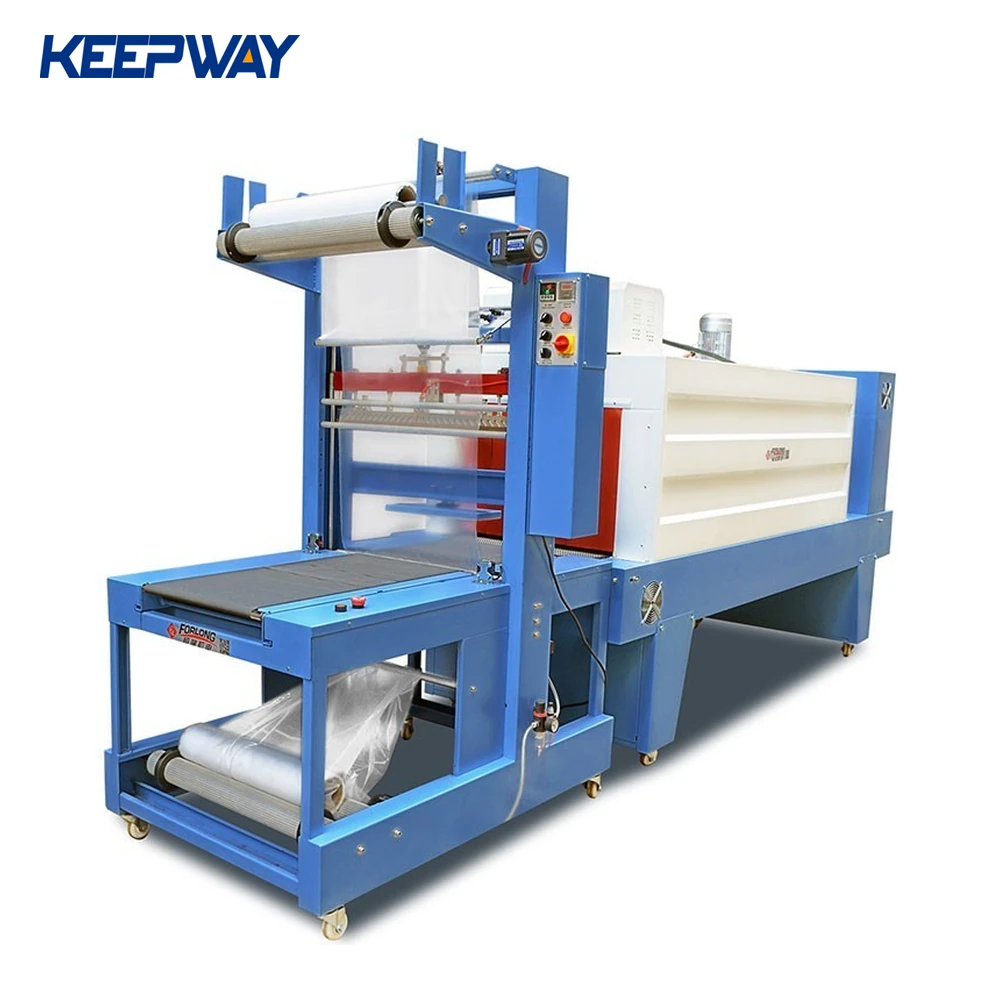
Identify the desired end openings. A sleeve bundle and an individually enclosed retail pack are different formats. Review the semi-automatic sleeve sealer and tunnel for the bundle discussion; compare an L-sealer configuration when an enclosing film bag is required. Neither name alone establishes a hermetic or liquid-tight pack.
2. Send the complete container system
Provide the filled product weight, container material and drawing, closure type, closure condition, label construction and normal product temperature at packing. Include handles, pumps, overcaps and any carton insert used in production. An empty unlabelled bottle can answer a layout question, but it cannot confirm the appearance and behaviour of the finished filled pack.
Ask the product and container suppliers to identify applicable heat-exposure limits and any restrictions on the proposed process. Where product behaviour or handling requirements are uncertain, resolve them before arranging a trial. State explicitly whether trial contents are the sale formulation or an agreed substitute; do not treat the two as interchangeable evidence.
3. Identify the film and the supporting components
Send the film supplier's grade and material description, thickness, roll width, core size, roll dimensions and relevant sealing/shrink guidance. Include an actual roll or an agreed trial quantity. “Clear shrink film” is not a complete purchasing specification.
If using a tray, pad or secondary carton, supply the production version with the intended surface finish and dimensions. Record whether a quoted line includes product grouping and tray handling or expects an operator to present the bundle. Do not purchase a sealer on the assumption that it also forms trays, counts bottles or creates the complete bundle.
4. Agree a sample matrix before the test
List each combination of product, unit count, support and film that needs approval. Include the smallest and largest intended packs and any format with an unusual handle, soft wall or tall profile. Decide the sample quantity and the acceptance criteria with the parties reviewing the result; there is no universal sample quantity for every project.
Use a shared record with these fields:
- Sample ID and revision: product, fill condition, closure, label, support and film lot.
- Equipment: quoted sealer and tunnel models, included handling equipment and selected configuration.
- Trial conditions: recorded machine settings, feed arrangement and operator tasks.
- Pack observations: seal appearance, film openings, container shape, label condition and readable information.
- Handling result: the agreed transfer, collection and subsequent handling assessment.
- Decision: accepted combination, rejected combination or further trial required, with dated photographs.
Assess packs after the agreed cooling or observation period as well as at the tunnel exit. If a different bottle, label, support or film is introduced later, record the change and decide what needs rechecking. An approved photograph without the corresponding sample specification is difficult to reproduce.
5. Measure the complete workstation
For semi-automatic operation, include arranging the units, loading, sealing, shrinking, collecting the pack and preparing the next group. Record acceptable finished bundles over the agreed trial period, together with interruptions and operator involvement. Conveyor speed or a sealing stroke is not the output of the complete workstation.
Compare alternative quotations using the same pack definition. Separate the sealer, tunnel, conveyors, grouping aids, film supply and site services. For the FL-7540 specification shown on our sleeve-sealer page, table height can be specified as 500 mm or 800 mm, with customization available. These are configuration choices, not a claim that every delivered table adjusts through that range.
Send a brief that supports a useful quotation
Provide finished-product photos, an assembled-pack drawing, dimensions and weight, film information, representative samples, target bundles per shift, changeovers, destination country and electrical supply. Add a floor sketch and upstream/downstream conveyor information where relevant.
Discuss your laundry-product shrink pack
Ask Keepway to review the proposed pack format, equipment scope and sample requirements. Identify the combinations needing a trial before finalizing the configuration.
Send your product and bundle details · Review bottle-bundle requirements
Keepway offers a two-year warranty, free replacement parts and their shipment during the warranty period, and lifetime service support.
Reference context
SMIPACK's BP range separates film-only, pad-and-film and tray-and-film formats by model. Sealed Air's shrink-film range distinguishes films for different packaging needs. These references support checking format and material together; their equipment ratings and film performance are not Keepway test results.