
Which orders from a shift should you test on a poly mailer bagger?
Before a supplier demonstrates a poly mailer bagger, ask your dispatch supervisor to choose the orders. A rail of neatly folded shirts can make loading look easy even when the afternoon shift handles hoodies, bundles and inserts. One tray should reproduce the mix your packers actually see. A second, clearly marked tray should show which awkward orders the proposed setup can handle.
Start with the parcels that reached this packing bench
Choose a completed shift and mark its date, station and order cutoff. Count one intended outbound parcel per row. A customer order split across two mailers contributes two rows. Include parcels routed to manual packing because the usual mailer was difficult to use, and mark that route. Exclude cancellations that never reached packing. Use anonymous codes such as P01 in the trial sheet.
For each row, record only what changes the packer's work. Three useful starting groups are compact single items, bulky single items and multi-item parcels. Put a bulky two-piece order in the multi-item group and flag its thickness separately. Other flags might be a loose insert, a different bag width or a change of fold. This keeps the shift total accurate while preserving the awkward combinations.
Turn the shift count into a pick list
Allocate each group a share of the trial tray in proportion to its share of parcels. Suppose a shift dispatched 240 parcels and the trial has room for 12. The numbers below illustrate the arithmetic. Twelve is a convenient example, and the appropriate trial size depends on the range of work you need to cover.
- For the 140 compact single-item parcels, 140 ÷ 240 × 12 gives seven places in the tray.
- For the 80 bulky single-item parcels, reserve four places.
- For the 20 multi-item parcels, reserve one place.
Within each group, sort the orders by packing time, divide the list into as many consecutive sections as you have places, and draw one order at random from each section. For the 140 compact orders above, that means seven sections of 20. Write down the chosen codes before anyone looks for the garments. If one is unavailable, record the reason and draw its replacement from the same section. Finally, place the selected orders back in dispatch sequence.
If a whole category disappears through rounding, flag it on the second tray. Check whether the shift included the morning intake and the last carrier pickup. A promotion or a returns-heavy Monday may deserve its own trial if the normal shift misses those conditions. Statistics Canada's explanation of grouped sampling gives the underlying selection principle.
Keep a separate tray for orders most likely to need intervention
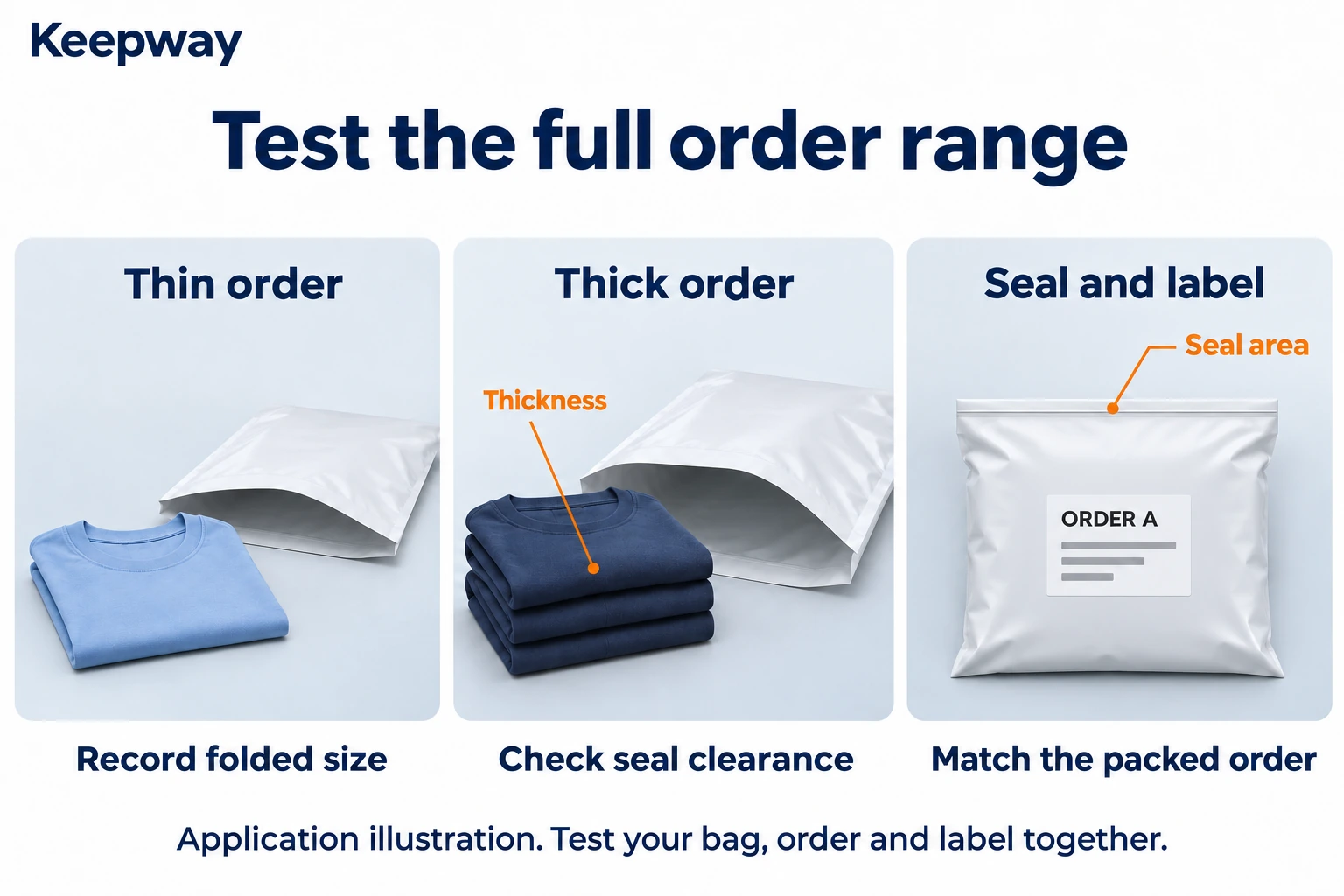
Ask the packer for one real example behind each recurring exception. A hoodie that springs open during loading tests whether the garment stays clear of the seal. A bundled order with a loose card tests whether all pieces travel into the mailer together. A wide fold tests clearance at the opening. Tag each sample with the specific observation that would make you accept it, change the fold or route it to hand packing.
On the trial record, label the trays “shift mix” and “challenge.” If an awkward item occurs naturally in the shift tray, leave it there. Give any extra repetitions a challenge code, so a deliberately difficult run cannot distort the share of orders that usually need rework.
Use the same sample list for each supplier
Keep the anonymous code, group, usual bag and reason for selecting each parcel on one sheet. Photograph its normal presentation if the packer will recreate it at another site. Ask each supplier to identify any substitution or sample they could not run. If every thick order needed refolding, you have a specific loading question to resolve before comparing quotations.
Bring the trays to the Keepway horizontal courier bag packing machine review. Once the batch is agreed, use the mixed-order timing guide to record what happened during the run. If the issue follows one garment, the paired fold comparison shows how to isolate it.