
COUNTING MACHINES · BUYER'S SAMPLE TRIAL
How to Test a Paper Counting Machine with Known-Quantity Samples
Define what counts as one item, establish an independent reference quantity and record each trial separately before choosing a paper counter for production.
Published 18 October 2026 · Keepway Machinery
Start with the quantity your customer actually buys
A print shop may deliver loose sheets, complete booklets or packs of envelopes. These are different counting tasks. A machine display showing 500 is useful only when everyone agrees what the 500 represents and how the reference quantity was established.
For a loose-paper order, one item can mean one sheet. For a finished-booklet order, it can mean one complete booklet, regardless of the number of pages inside. Counting booklets does not verify their internal page count. Record the unit on the trial sheet and keep different item types separate.
This guide describes a buyer-and-supplier trial workflow, not a standardized certification test. Agree the sample conditions and acceptance criteria for your order before testing.
1. Prepare representative material and a checked reference
Identify the actual paper or finished product: item dimensions, paper weight or thickness where known, coating, folds, binding, window openings and normal stack height. Include photographs of the counting edge. Use material from the intended production process rather than a convenient substitute.
Establish the reference count independently of the machine being evaluated. For example, a person can count the sample in small groups and a second person can independently verify it. If the two references disagree, resolve the difference before using that stack in a trial. Record the reference quantity, how it was checked and who checked it.
Keep a sample identifier with the stack. Count any items added or removed during setup, and recheck the reference if the stack's contents become uncertain. The purpose is to compare the machine against a known quantity, not against another unverified display.
2. Separate repeated counting from operator loading
Begin with one representative material, one recorded stack and an agreed setting. Run the same stack repeatedly under the same conditions, recording each displayed result. Then include trials in which the operator unloads, aligns and reloads the stack as they would during normal work. This helps distinguish a repeated count from the complete handling process.
Record the setting and stack condition for every run. If a result changes after an adjustment, retain the earlier result and explain the change. Do not quietly replace an unsuccessful run with the best result. Agree the number of trials with the supplier; a single successful demonstration does not establish consistency across production.
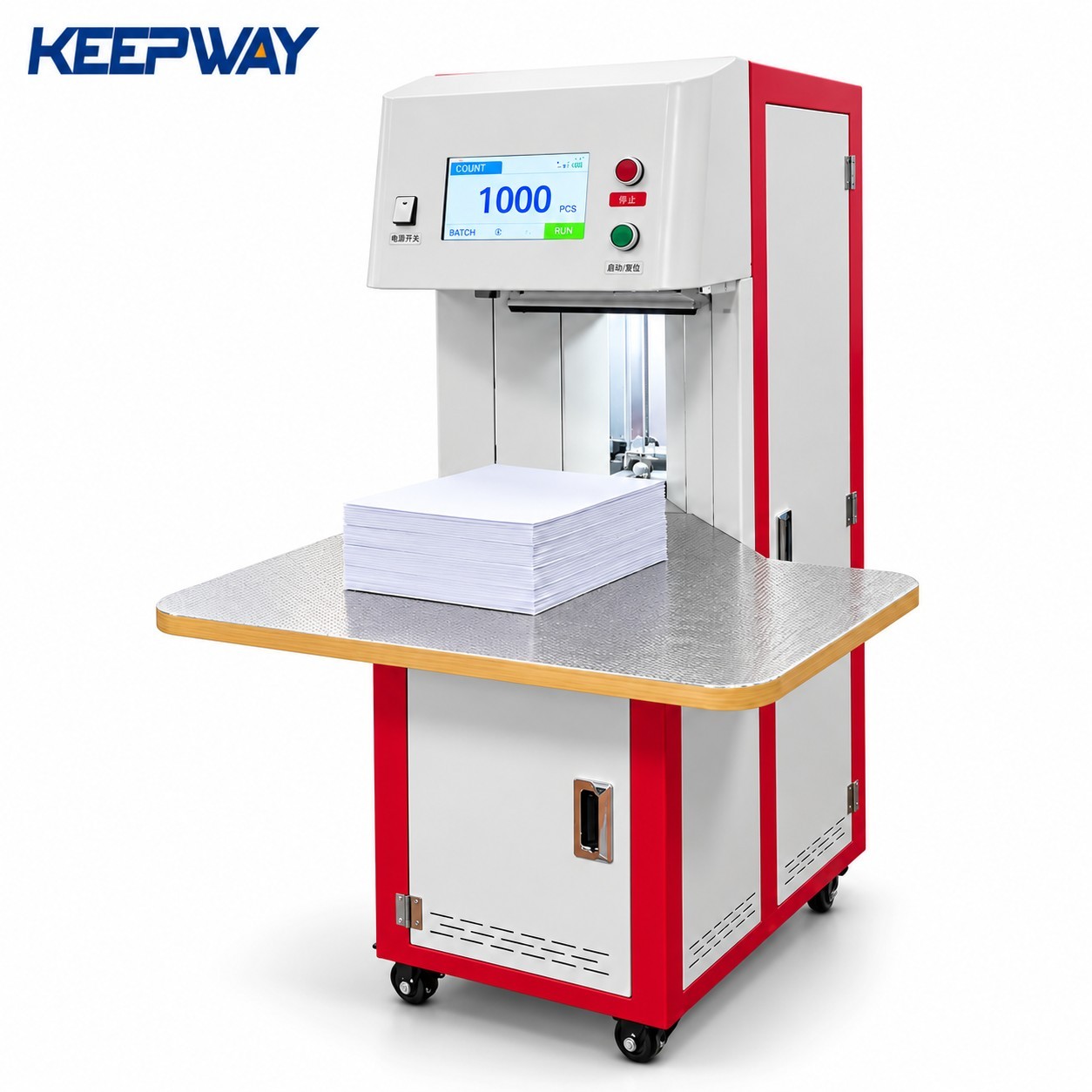
For the KPW-500A paper counting machine, the supplied loose-sheet specification is 300–1000 sheets/min, with a listed accuracy of ±1 sheet. Those figures do not define a complete acceptance method or guarantee the same rate for whole notebooks, booklets or envelopes. Confirm the material, stack and test conditions for your order.
3. Record the error for each run
Write down the reference quantity and displayed count side by side. The signed difference is the displayed count minus the reference count. Keep the individual differences visible: an overcount in one run does not cancel an undercount in another.
| Illustrative run | Known quantity | Displayed count | Difference |
|---|---|---|---|
| A | 200 | 201 | +1 |
| B | 200 | 199 | −1 |
These numbers are a worked example, not Keepway test results. Their average signed difference is zero, but neither run matched the reference exactly. Decide whether each result meets the previously agreed criterion and record any unresolved variation.
A batch-setting control also needs a clear definition. Confirm what happens when the target is reached. A batch number on the display does not, by itself, mean the machine inserts tabs, physically separates batches or packages the counted items.
4. Test the materials and stack conditions that matter
After establishing a baseline, vary one relevant condition at a time. Examples include the ordinary production stack height, a different paper finish or a second booklet construction. Keep these within the model's confirmed working range. Record the change so a result can be traced to its actual conditions.
For KPW-500A, the supplied paper-size range is 50 × 50 to 320 × 450 mm and the listed stack-height range is 30–100 mm. A working table measuring 700 × 550 mm does not extend the stated paper-size range. Dimensions alone also do not prove that a particular coated stock, bound item or filled envelope is suitable.
No universal paper-weight or thickness range is specified here. Provide representative samples for assessment. Test complete notebooks, booklets and envelopes as their own item types; do not translate a sheets-per-minute rating into a finished-item throughput promise.
5. Measure the complete counting cycle
For staffing and delivery planning, observe the practical workflow: prepare and align the stack, load it, count, read or record the result, unload and handle any repeat checks. Record interruptions and their causes. Compare accepted output over the observed working period rather than quoting only the counting-head setting.
Use the same operator instructions and material definition when comparing candidate equipment. Agree which handling steps are included in the timed period. If a trial uses an unusually tidy sample or excludes preparation, note that limitation in the quotation review.
Agree the acceptance record before ordering
Download a blank paper-counter trial record. Leave result fields blank until the test has actually been performed.
- Define the item, sample identifier and independently checked reference quantity.
- Record material dimensions, thickness or gsm if known, stack height and condition.
- Agree settings, trial repetitions, allowable deviation and how failed runs will be handled.
- Record each result, unloading/reloading conditions and complete-cycle output separately.
- Confirm the supplied machine configuration, local voltage, frequency, phase and destination.
Keep the accepted record with the quotation so the supplied configuration and agreed trial conditions can be checked together. Photos or a video can document the procedure, but they do not replace the recorded reference and individual results.
Discuss your paper or finished-product counting task
Send Keepway the item type, dimensions, stack height, target batch quantity, required practical output and representative photographs or samples. For booklets or notebooks, state that one complete item is the counting unit.
Request a KPW-500A sample assessment Explore Counting Machines